Dyna Industries · E-Commerce
Dyna Industries
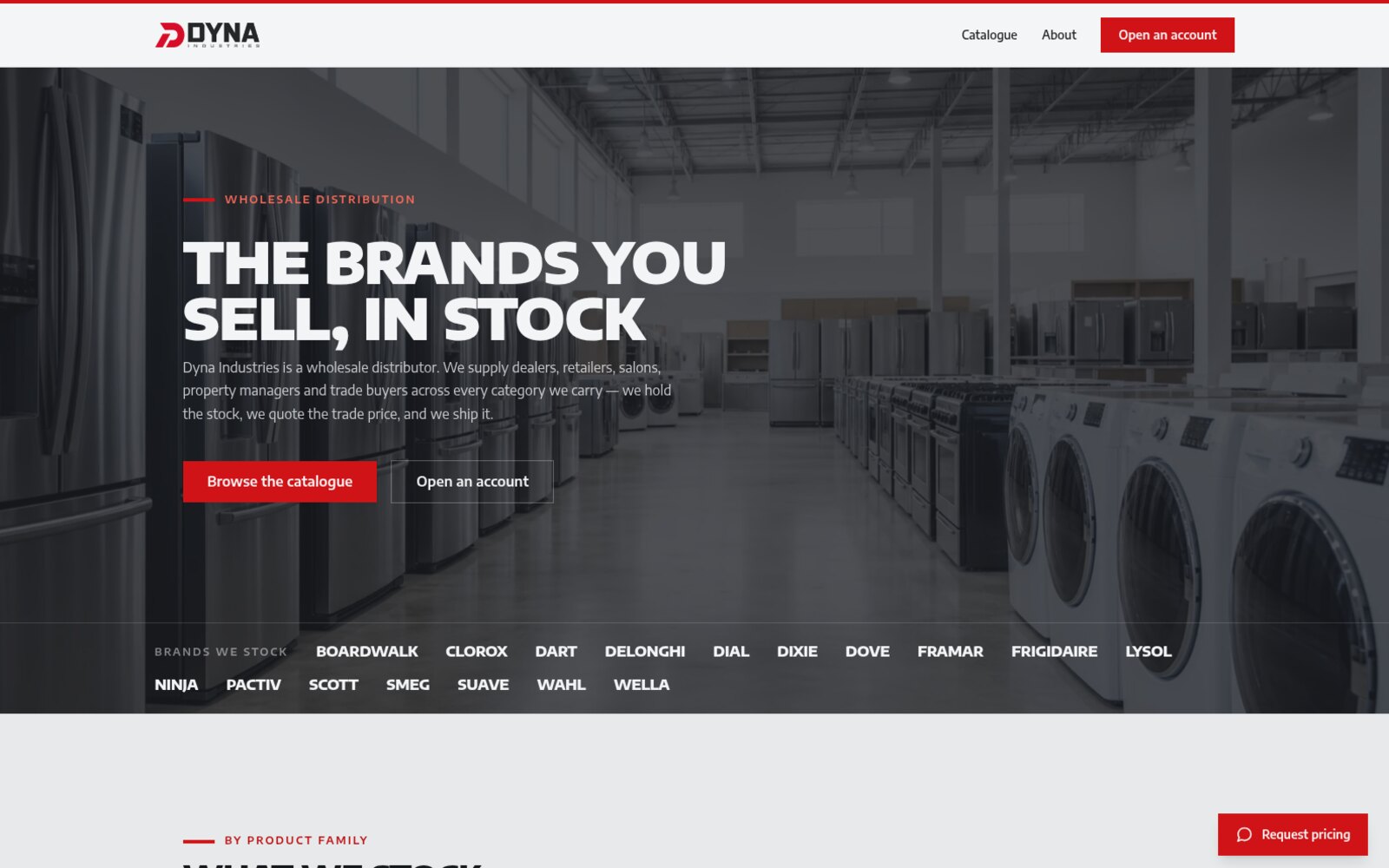
A Montreal wholesale distributor’s full line card online — browse by brand or by category, see the trade terms before you ask, and request pricing on the exact models you are specifying.
Who Dyna Industries Are
Dyna Industries is a Montreal-based wholesale distributor — the supply behind the order. They stock the brands other people build and supply them to dealers, retailers, salons, property managers and trade buyers, on trade terms, from stock. They are explicitly a distributor rather than a manufacturer, and the site says whose product it is on every page, because a buyer specifying an order needs to know exactly what is arriving.
What They Carry
The line card runs across five categories rather than one vertical: major and countertop appliances, retail-pack personal care, back-bar and professional salon supply, cleaning and janitorial, and foodservice disposables. The roster currently includes Frigidaire, Smeg, Ninja and DeLonghi alongside Dove, Suave, Dial, Wella, Wahl and Framar, plus Clorox, Lysol, Scott, Boardwalk, Dixie, Dart and Pactiv — and they source beyond it on request.
That breadth is the commercial argument the site had to make. Sourcing across categories normally means several suppliers, several minimums and several delivery windows; through one Dyna account it is one order, one contact and one freight arrangement.
Terms Up Front, Price By Account
Minimum order quantity, case format, pack format, unit of measure and stock status sit on the model page itself rather than in a PDF a buyer only receives after asking. Price is the one thing deliberately not shown: it depends on volume and terms, so it is quoted per account. The site is built around that — every model page invites a pricing request on that specific item instead of implying a shelf price exists.
What The Site Does For Their Buyers
A trade buyer arrives one of two ways — "what Smeg do you stock?" or "what undercounter refrigeration do you stock?" — so both brand and product family are top-level ways in, alongside search by product name, model number or SKU. Each model page carries the manufacturer's own published specification, restated in full rather than summarised, with the trade terms beside it and one clear next step: request pricing, or open a wholesale account.
How It Made Their Lives Easier
Dyna manage their catalogue in one place — their Nova CRM — and the website follows. Adding a product, correcting a specification, adjusting stock or bringing on a whole new category happens once, in the system they already work in, and the public catalogue reflects it. There is no second content system to keep in step and no product typed in twice.
The same applies to the things that usually go stale on a distributor's website. The brand roster and the category counts are generated from the live catalogue rather than maintained by hand, so they are accurate on the day a buyer reads them instead of accurate on the day someone last remembered to edit them.
Pricing requests land where the work already happens: an inquiry arrives in the CRM as a lead with the model the buyer was looking at attached, so quoting starts with the context instead of a reply asking which unit they meant. Enquiries from paid campaigns carry their attribution through, so Dyna can see which spend produced which account conversation. And because trade pricing never appears publicly, they keep full control of what is quoted, to whom, at what volume.
The Stack
Built on Laravel 12 with Inertia 2 and Vue 3 in TypeScript, server-side rendered so search engines receive fully formed pages, styled with Tailwind CSS 4, animated with GSAP, and bundled with Vite. The catalogue, the inquiry pipeline and the lead records are all Nova CRM.
Key Features
- Full trade catalogue browsable by brand and by product family, with search across name, model number and SKU
- Model pages carrying the manufacturer's own specification in full, with minimum order quantity, case and pack format, unit of measure and stock status
- Per-account pricing — no public prices anywhere, with a pricing request attached to the specific model
- Catalogue managed once in Nova CRM and reflected on the site, with no second content system to maintain
- Brand roster and category counts generated from the live catalogue rather than hand-maintained
- Inquiries delivered into the CRM as leads, with paid-campaign attribution carried through
- Wholesale account sign-up as the single, consistent call to action across the site
- Server-side rendered pages, a generated sitemap and clean canonicals so the catalogue is properly indexable
- Mobile-first layout with motion that never gates the content behind it
Technologies: Laravel 12, Inertia 2, Vue 3, TypeScript, Tailwind CSS 4, GSAP, Vite, NovaCRM